
7 August 2026
Scientific reviewPower Green: what the scientific literature says about its components
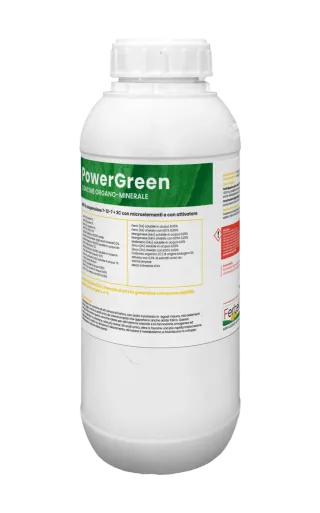
Power Green is an organo-mineral NPK 7-12-7 fertiliser enriched with chelated micronutrients, seaweed and humic acids from vermicompost. The composition brings together macronutrients high in phosphorus, with nitrogen and potassium in equal measure, and six micronutrients (boron, copper, iron, manganese, molybdenum and zinc), four of which (copper, iron, manganese and zinc) are also present in EDTA-chelated form, plus a supply of organic carbon and humic acids extracted from Fertek vermicompost. On the label, the product is indicated for stimulating more even and uniform flowering and for promoting the growth and ripening of the fruit. What does the scientific literature say about the individual components of this formulation?
Phosphorus and potassium in flowering and fruit quality
Potassium is among the most studied elements for its effect on the final quality of the fruit. In a study on sweet orange (Citrus sinensis) published in Horticulture Research, potassium stimulated sugar accumulation in the fruit by increasing the flow of carbon from the leaves to the fruit[1]. In the field trials of the same work, potassium fertilisation increased the weight of the individual fruit, the number of fruits per plant and the overall yield[1]: this was, however, a dedicated potassium fertilisation, whereas in Power Green potassium is at 7% of a formulation applied at the label rates mentioned at the end, which are much lower than the experimental ones. Phosphorus, present in Power Green at 12% as phosphorus pentoxide, is traditionally associated with flowering and root development: it is widely held among agronomists that a readily available supply of phosphorus in the pre-flowering stages supports flower formation, although the effect varies greatly depending on the crop, the phenological stage and the phosphorus already present in the soil.
Boron, a key element in flowering
Power Green contains water-soluble boron at 0.03%. It is commonly believed that boron is among the micronutrients most closely linked to the success of flowering, because of its role in pollen germination and pollen tube growth, and that for this reason the reproductive phase of the plant suffers more from its deficiency than vegetative growth does. A study on macadamia measured an increase in pollen viability of 95.7% and in floral raceme elongation of 24% in plants treated with boron compared with the control[2]. In the same study, boron application led to a final yield 43% higher and a fruit number 39% higher[2]. Those figures, however, come from a boron treatment applied specifically in the study: Power Green supplies boron at the label rates, much lower than the experimental rates of that study.
Seaweed as a biostimulant
Power Green includes seaweed among its components: the label stops at this generic wording and does not state the species, whereas the available research concerns identified species. The link between the wording on the label and the species studied is not documented for the product. It is widely held that brown seaweed extracts are among the most studied biostimulants in horticulture. In a two-year trial on pepper and aubergine, the foliar application of an extract of Ascophyllum nodosum significantly increased the total fruit yield, mainly through a higher number of fruits per plant[3]. The authors themselves write that the reason for the increase in fruit number remains to be clarified and put forward two alternative hypotheses: that the extract increases the number of flowers, or that it promotes the formation and retention of fruit set by acting on factors such as pollination and fertilisation efficiency and the early loss of fruitlets[3].
Humic acids from vermicompost
Humic extracts from vermicompost are the distinctive feature of Fertek fertilisers and are present in Power Green at 0.3%. On rice, the application of humic acid extracted from vermicompost increased root dry weight by 27% and lateral root length by 20%[4]: the same mechanism is explored in more depth in our article on humic and fulvic acids from vermicompost. A second study, carried out on oilseed rape (Brassica napus), reports in its discussion the mechanism by which vermicompost increases phosphorus uptake: the activation of soil microorganisms, which release organic acids and stimulate phosphatase activity[5]. The same authors also recall, from earlier literature, that as the amount of vermicompost in the substrate increases, the levels of zinc, calcium and nitrogen in the above-ground part of the plant rise significantly[5].
Chelated micronutrients
In Power Green, copper, iron, manganese and zinc are present both in soluble form and chelated with EDTA. It is commonly believed that chelation serves to keep the micronutrient available for foliar or root uptake, rather than precipitating or binding to other components of the solution. In a trial on rice grown on a vertisol in central India, grain yield increased significantly with the foliar application of zinc chelated with EDTA, which proved superior to all the other zinc sources compared[6].
None of these studies concerns Power Green as such: they deal with the individual components (potassium, boron, seaweed, humic acids from vermicompost, chelated zinc) on different crops (citrus, macadamia, pepper and aubergine, rice, oilseed rape) and at the rates specific to each experiment. In short, besides the product and the crop, the rate also changes: Power Green supplies these elements at the label rates (200 to 300 grams for every 1,000 square metres in fertigation, 50 to 100 grams for every 100 litres of water in foliar fertilisation), quantities far lower than those applied in the studies cited. It is widely held among agronomists that combining these elements in a single foliar or fertigation formulation produces a complementary effect on the plant, more than the simple sum of the individual inputs, but this remains a working hypothesis shared across the industry, not an experimental result specific to this product.
References
The numbered statements refer to the verified source listed below; the others report positions shared in the specialist literature, without a specific citation.
- [1] Wu K., Hu C. et al.. Potassium stimulates fruit sugar accumulation by increasing carbon flow in Citrus sinensis. Horticulture Research, 2024. https://pmc.ncbi.nlm.nih.gov/articles/PMC11540757/
Original quotation
"The findings reveal that K stimulates fruit sugar accumulation by increasing carbon flow from source leaves to fruit in Newhall navel orange." (The findings reveal that potassium stimulates fruit sugar accumulation by increasing carbon flow from source leaves to fruit in Newhall navel orange.); "Pot experiment results showed that K application induced fruit enlargement and color turning, which was consistent with the field experiment results that K application increased the single fruit weight, fruit number per plant, and yield of Newhall navel orange." (Pot experiment results showed that potassium application induced fruit enlargement and colour turning, which was consistent with the field experiment results that potassium application increased the single fruit weight, fruit number per plant and yield of Newhall navel orange.)
- [2] Zhou Z.-J., Zhao Z.-X. et al.. Boron Supplementation and Phytohormone Application: Effects on Development, Fruit Set, and Yield in Macadamia Cultivar 'A4' (Macadamia integrifolia, M. tetraphylla). Plants (Basel), 2025. https://pmc.ncbi.nlm.nih.gov/articles/PMC12389283/
Original quotation
"Our findings revealed that B treatment significantly increased pollen viability (95.69% improvement) and raceme length (23.97% increase)" (Our findings revealed that boron treatment significantly increased pollen viability (95.69% improvement) and raceme length (23.97% increase)); "Notably, B application significantly improved total yield (43.11% increase) and fruit number (39.12% increase)" (Notably, boron application significantly improved total yield (43.11% increase) and fruit number (39.12% increase)).
- [3] Staykov N., Kanojia A. et al.. Sustainable agriculture through seaweed biostimulants: a two-year study demonstrates yield enhancement in pepper and eggplant. Frontiers in Plant Science, 2025. https://pmc.ncbi.nlm.nih.gov/articles/PMC12450877/
Original quotation
"ANE application significantly increased total fruit yield, primarily through higher fruit numbers per plant and, to a lesser extent, increased fruit size/weight, with hints to these effects traced back to earlier developmental stages." (ANE application significantly increased total fruit yield, primarily through higher fruit numbers per plant and, to a lesser extent, increased fruit size/weight, with hints to these effects traced back to earlier developmental stages.); "Why ANE is causing increase in the fruit number, is a matter, deserving further investigation, although two main reasons might apply: 1. ANE causes an increase in the number of flowers, or 2. ANE enhances the process of formation and/or retention of fruit sets by influencing some of its required components, such as pollination/fertilization efficiency, fruit set abortion, early fruit set losses and further fruit survivability at later stages." (Why ANE is causing an increase in the fruit number is a matter deserving further investigation, although two main reasons might apply: 1. ANE causes an increase in the number of flowers, or 2. ANE enhances the process of formation and/or retention of fruit sets by influencing some of its required components, such as pollination/fertilisation efficiency, fruit set abortion, early fruit set losses and further fruit survivability at later stages.)
- [4] Faria de Souza A.F., Calderín García A. et al.. Humic Acid Regulates Root Growth through ROS-Dependent Pathway and Hormone Signaling in Rice. Journal of Agricultural and Food Chemistry, 2025. https://pmc.ncbi.nlm.nih.gov/articles/PMC12355950/
Original quotation
"HA application increased root dry weight by 27% and lateral root length by 20%." (Humic acid application increased root dry weight by 27% and lateral root length by 20%.) The humic acid used is extracted from vermicompost: "humic acids (HA) extracted from vermicompost" (humic acids extracted from vermicompost).
- [5] Hemati A., Alikhani H.A. et al.. Effect of Different Enriched Vermicomposts, Humic Acid Extract and Indole-3-Acetic Acid Amendments on the Growth of Brassica napus. Plants (Basel), 2022. https://pmc.ncbi.nlm.nih.gov/articles/PMC8781061/
Original quotation
"Vermicompost enhances phosphorus absorption by increasing phosphorus through activating microorganisms via secreting organic acids such as citric, glutamic, succinic, lactic, oxalic, malic, and fumaric acids or stimulating phosphatase activity" (Vermicompost enhances phosphorus absorption by increasing phosphorus through activating microorganisms via secreting organic acids such as citric, glutamic, succinic, lactic, oxalic, malic and fumaric acids or stimulating phosphatase activity); "It has also been observed that by increasing the amount of VC in the culture medium, the amount of elements such as zinc, calcium, and nitrogen significantly increase in the plant aerial parts" (It has also been observed that by increasing the amount of vermicompost in the culture medium, the amount of elements such as zinc, calcium and nitrogen increases significantly in the aerial parts of the plant). Both sentences are reported by the authors from earlier literature (respectively ref. [80] in the Discussion and ref. [12] in the Introduction); they are not measurements from the authors’ own oilseed rape experiment.
- [6] Kulhare P.S., Tagore G.S. et al.. Effect of foliar spray and sources of zinc on yield, zinc content and uptake by rice grown in a vertisol of central India (source available in abstract only). International Journal of Chemical Studies, 2017. https://chemijournal.com/archives/?ArticleId=416&issue=2&vol=5&year=2017
Original quotation
"The rice grain yield significantly increased with the foliar application of Zn-EDTA over all the sources of Zn but the other Zn sources were found on par amongst themselves." (Rice grain yield increased significantly with the foliar application of Zn-EDTA compared with all the zinc sources, while the other zinc sources were found to be equivalent to one another.)